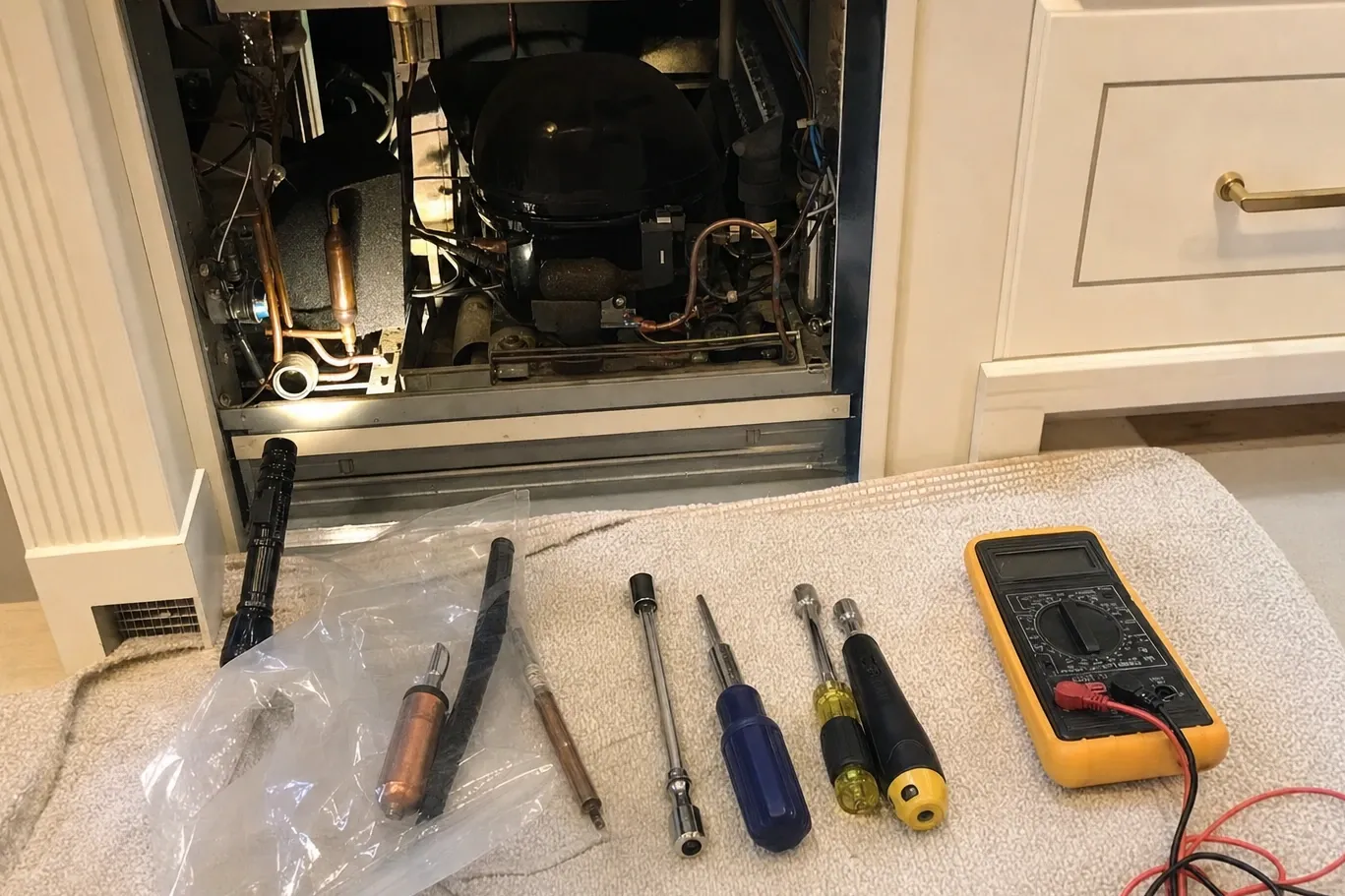
Refrigerator Repair
Sub-Zero Settings: Setpoints, Sabbath Mode and Showroom Traps
Put together by
Rosalind Okafor
Refrigeration technician — dual-refrigeration and column units · 22 years in the trade
Treats a dual-refrigeration cabinet as two machines that happen to share a door line, and diagnoses the halves separately. The evaporator that frosts and the one that never does are rarely failing for the same reason.
EPA 608 certified
Licensed, bonded and insured — licence number on request.
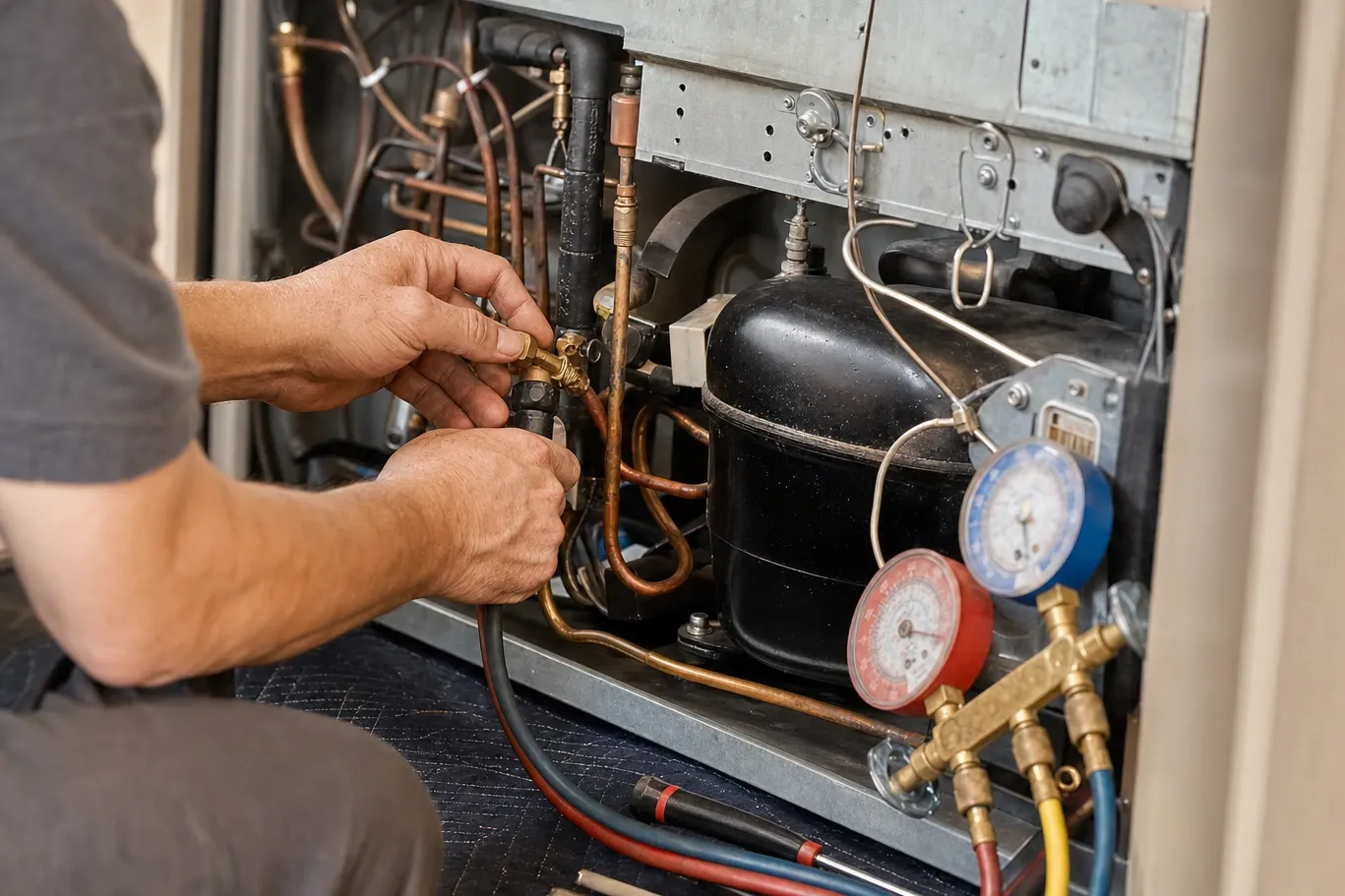
For most kitchens, the best Sub-Zero settings sit close to where the controls start: 38°F for fresh food and 0°F for the freezer, nudged a single degree at a time only when the food tells you to. What confuses people are the special modes. Sabbath Mode, Showroom Mode, Max Ice and the drawer controls each change how the unit behaves, and two of them can make a healthy refrigerator look broken. In West Loop and River West condo buildings, where the refrigerator often came with the home rather than being picked by the owner, it pays to rule out a leftover mode before paying anyone to hunt for a failed part.
Start with the setpoints, not the extremes
On Classic (CL) and Designer (DET, DEC) models the controls arrive at 38°F (3°C) in the refrigerator and 0°F (-18°C) in the freezer, and every press shifts the setpoint by one degree. Those defaults suit an ordinary family kitchen. Turning the control to its coldest does not make groceries last longer; mostly it freezes the milk against the back wall and keeps the compressor busier than it needs to be.
Each family of models has its own adjustable window:
| Compartment | Models | Adjustable span |
|---|---|---|
| Refrigerator | Classic (CL), Designer (DET, DEC) | 34°F to 42°F |
| Refrigerator | Classic (BI), Designer (IT, IC, ID) | 34°F to 45°F |
| Freezer | the same models | -5°F to 5°F |
| Wine storage | Designer (IW, DET, DEC), Classic (BW, CL), UW-24 | 39°F to 65°F |
On those wine units either zone will hold red or white, so no bottle is ever in the wrong compartment. To find out whether the display is honest, stand a thermometer in a cup of water in the center of the cabinet for the night and read it before anyone opens the door. Change one thing, give it a full day, then measure again.
Drawer modes
Refrigerator drawers on CL, DET and DEC units run in one of two modes. Auto Mode keeps them 2° colder than the main setpoint, but never below 34°F. Manual Mode lets you choose 2° warmer or 2° colder, still inside the 34°F to 42°F window. A drawer that feels chillier than the shelves above it is simply following Auto Mode, not losing cold air through a fault.
Sub-Zero Sabbath Mode, and what it quietly turns off
Sabbath Mode is there so that opening the door on a day of rest does not toggle the lights or set off the alarm. On Classic (CL), Designer (DET, DEC) and PRO models the interior lights stay on at reduced brightness even with the door shut, and the mode ends by itself after 74 hours. While it runs, the ice maker system and the door alarm are switched off and remain off.
That detail explains plenty of worried calls about a dead ice maker or a door that has stopped chiming. The mode also outlasts an outage: once power returns, the unit drops straight back into it. After a summer thunderstorm knocks out power on a Logan Square block, a household that set the mode for one holiday can find the ice bin still empty days later and blame the module.
Not every product offers it. The 600 Series, 700 Series and certain wine storage models include Sabbath Mode but need an accessory kit to satisfy Star-K requirements, while 500 Series refrigerators and UC-15I ice makers have no Sabbath Mode at all.
Showroom Mode: the setting that stops cooling
Showroom Mode lets a dealer light up a display model without running the refrigeration. Left on in a home, it lets the cabinet warm while the panel looks perfectly ordinary. On a Classic (BI) unit the display reads Sh r. To get out of it, press Power to turn the unit off, hold down a matching Warmer and Colder pair, press Power again, then release all three keys.
Current Classic and Designer models give a different clue: the display shows 38° and 0° even though the interior is plainly warm. For that situation Sub-Zero tells owners to phone its customer care line. A PRO 36 or PRO 48 left in Showroom Mode goes back into it after any power cut, and the only way out is the password-protected Service screen inside the Settings menu.
So when a Sub-Zero refrigerator is not cooling, rule this mode out first.
Max Ice, filter reminders and other normal behavior
Max Ice on CL, DET, DEC and PRO models lifts ice output by up to 30% for 24 hours. Over that day some components run faster and the unit may sound noticeably different, which is expected and fades when the cycle finishes. On Classic (BI), Designer (IT, IC, ID) and IW-30CI units the cube icon tells you the state: one cube shows the maker switched on, while a row of three shows Max Ice in progress. If the icon is lit and the bin stays empty, our walkthrough on checking the water before blaming the ice module covers the usual causes.
On CL, DET and DEC touch controls, a Snooze/Refresh prompt is simply a reminder that a new water filter or a fresh air purification cartridge is needed. Snooze holds the reminder off for 24 hours, and fitting a fresh part restarts that item’s countdown for roughly a year.
Display messages that look like faults
Two dashes (—) on a Classic (BI), 600 Series or 700 Series display mean that zone has been disabled, which can happen by accident while wiping the panel. To restore it, turn the whole unit off with the Power key; then, keeping a finger on the dark zone’s Warmer key, tap Power once more.
A Classic (BI) that keeps chiming can be quieted: press Alarm and Power at the same moment and release the pair before 5 seconds have passed. That hides the warning for 24 hours, yet the alarm went off for a reason, and the malfunction is still waiting when the day runs out.
When the settings are right and it still runs warm
If no mode is active and the thermometer still reads high, the cause is mechanical. On built-in refrigerators the common culprits are a failed fan motor, a defrost heater or sensor that has quit, the electronic control board, and less often the sealed system. Frost creeping across the rear panel points toward defrost, which our guide to frost that keeps coming back explains.
Typical ranges are $330–$660 for an evaporator or condenser fan motor, $290–$630 for a defrost heater, thermostat or sensor, $390–$880 for a control board, and $1,310–$3,000 for compressor or sealed-system work, with the firm number given once the fault is found. Our visit carries a flat $89 charge that includes the full diagnosis; approve the work and those $89 are subtracted from the repair total. For Sub-Zero refrigerator repair in Wicker Park, Logan Square, West Loop or River West, call (312) 487-4161.
Follow-ups
- Which Sub-Zero temperature settings work best for everyday use?
- The presets are the right starting point: current Classic (CL) and Designer (DET, DEC) controls arrive with the fresh-food side on 38°F and the freezer side on 0°F. Move one degree at a time, wait a full day, and check with a thermometer in a glass of water before changing anything else.
- How long does Sub-Zero Sabbath Mode stay on?
- On Classic (CL), Designer (DET, DEC) and PRO models it switches itself off after 74 hours. Until then the ice maker and the door alarm stay off and the lights remain dimly lit, and if the power drops out the unit returns to Sabbath Mode once it comes back.
- Why is my Sub-Zero warm when the display looks normal?
- Showroom Mode is the first thing to rule out, because in that mode the unit does not cool at all. A Classic (BI) display reads Sh r, while newer Classic and Designer models can show 38° and 0° even with a warm interior. If no mode is on, a fan, defrost part or control fault is likely.
- How much does a Sub-Zero that is not cooling cost to fix?
- It depends on the part, so the firm price follows diagnosis. Typical ranges are $330–$660 for a fan motor, $290–$630 for a defrost heater, thermostat or sensor, $390–$880 for a control board and $1,310–$3,000 for sealed-system work. The $89 service call is credited toward the repair once you approve it.
- Is it normal for my Sub-Zero to sound louder on Max Ice?
- Yes, a change in sound during Max Ice is expected. The feature raises ice output by up to 30% for 24 hours, and some components run faster while it is active. The sound should return to normal when that period ends.